How AI Eases the Project Manager's Day: Inside Doezze's AI Features
A practical look at how Doezze AI helps project managers, founders, and agency owners: AI planning, sprint prediction, semantic memory, and MCP integrations.
It's 9:05 AM. A project manager opens their laptop to a wall of red: overdue tickets, a sprint ending Friday, people on leave, and a client asking "are we on track?" The next hour disappears into status-chasing.
This is the part of project management nobody puts in the job description — and it is exactly what AI should be doing.
Here is how the AI inside Doezze turns coordination overhead into a two-minute conversation.
1. Describe the work, get the plan
Turn a vague brief into epics, tasks, owners, and a sprint plan with one prompt:
"Create a 3-sprint plan for a customer onboarding portal — auth, dashboard, billing, email notifications. Team of 4."
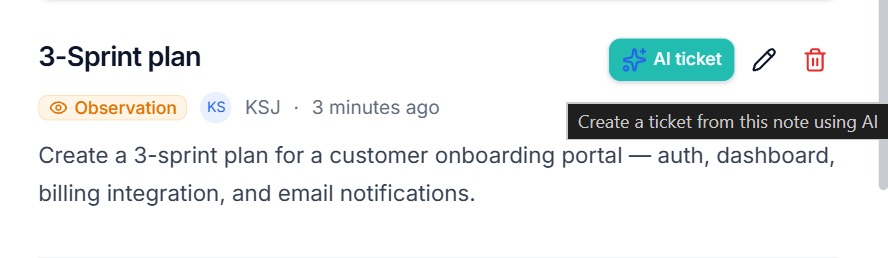
Doezze AI generates titles, descriptions, story-point estimates, acceptance criteria, and a sprint breakdown. You review and adjust instead of starting from zero.
2. Ask about your actual workspace
Generic chatbots answer generic questions. Doezze AI answers questions about your work.
- "What's blocking the payments sprint?"
- "Who has capacity next week?"
- "Draft a client update for the onboarding project."
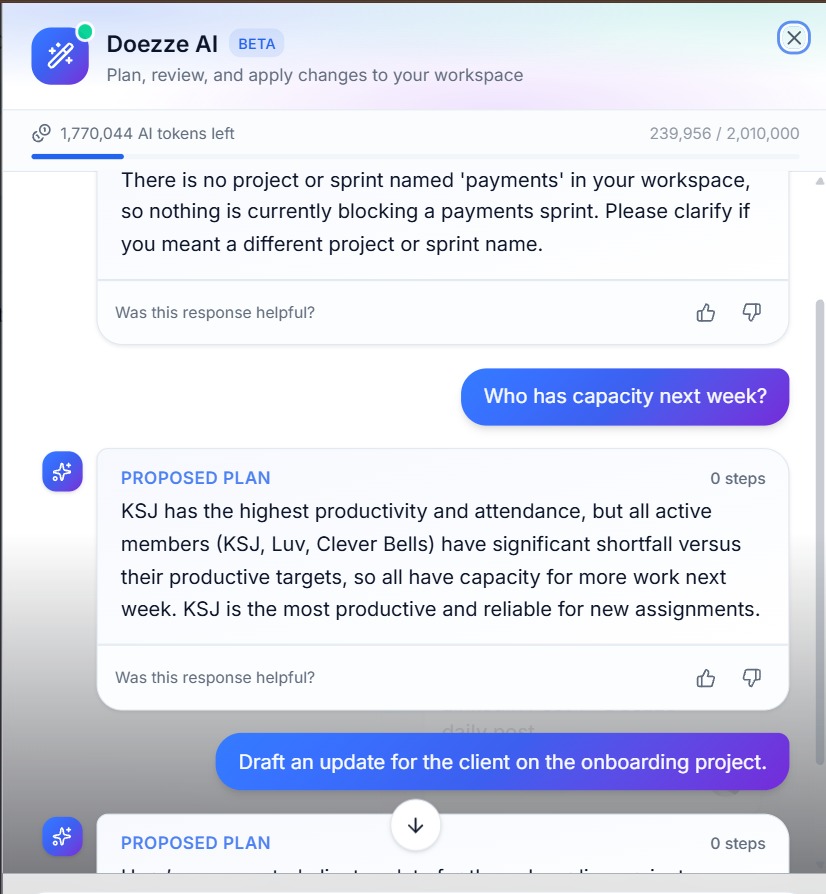
It can also act: create tasks, assign work, and draft sprint plans — with your permissions enforced.
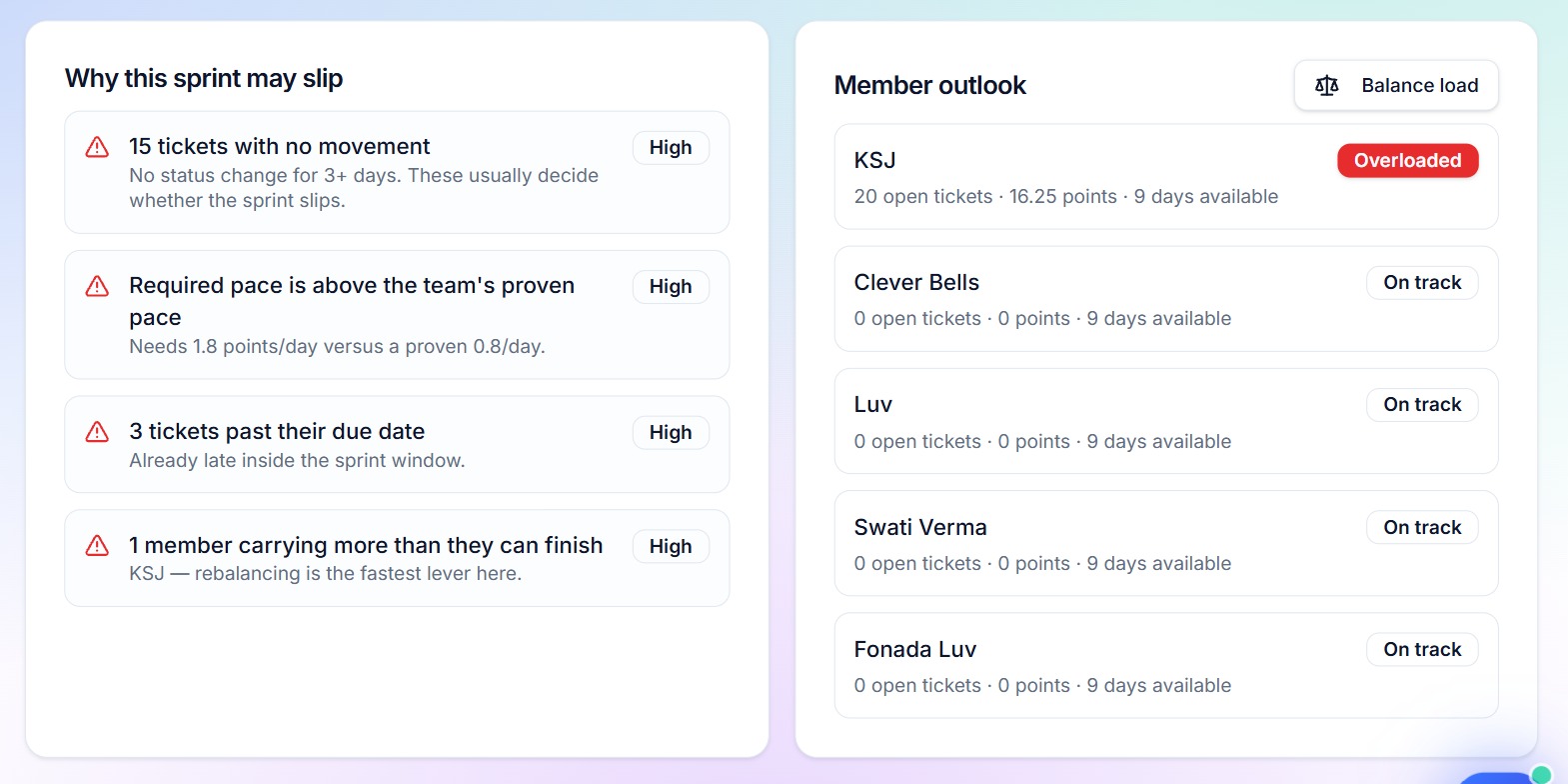
3. See the slip before it happens
Doezze analyzes velocity, remaining work, completion rates, and team availability to predict whether a sprint will finish on time.
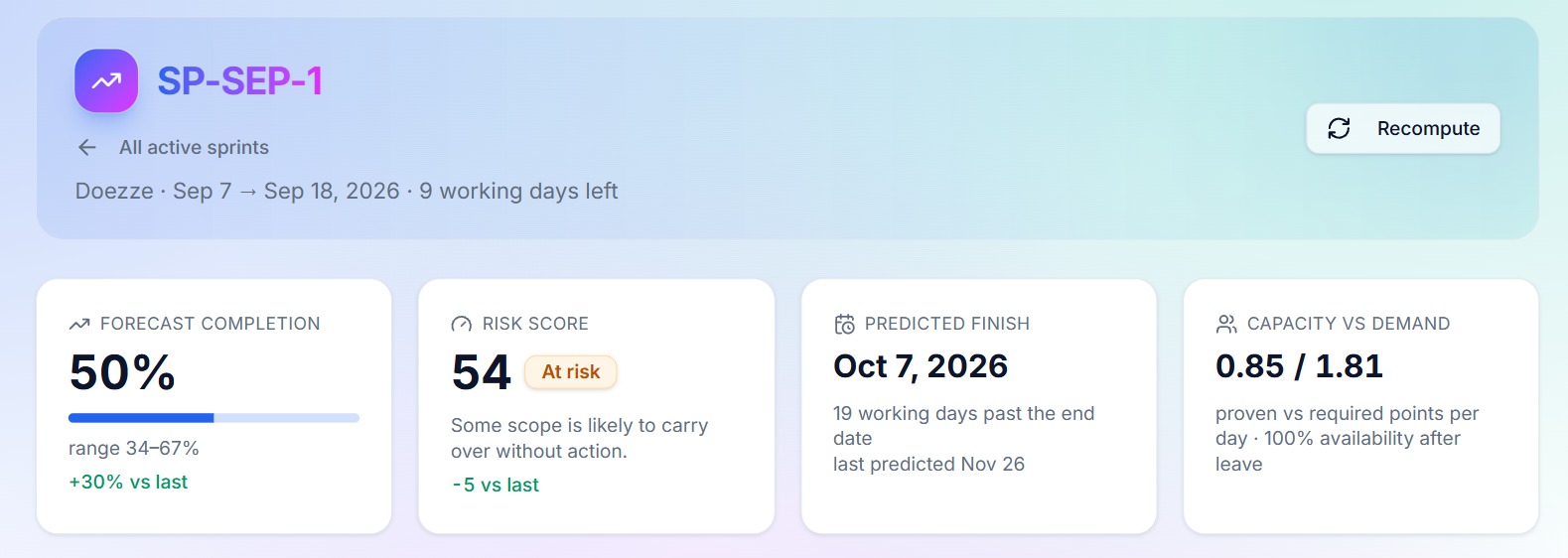
Instead of a surprise on day 9 of 10, you get a mid-sprint signal: "At this pace, the sprint lands at 78%." That gives you time to reassign, descope, or reset expectations.
4. Validate estimates and acceptance criteria
Doezze AI checks story-point estimates against your governance rules and flags ones that look off. It also nudges vague tasks toward testable acceptance criteria, so "done" means the same thing to everyone — including the client.
5. Remember everything your workspace already solved
Doezze builds semantic memory across tickets, comments, support requests, notes, and resources. A new support ticket is matched by meaning, not just keywords, so "Can't log in on mobile" connects to "authentication fails on iOS Safari." Strong matches auto-suggest solutions; moderate ones surface hints; duplicates get flagged before they pile up.
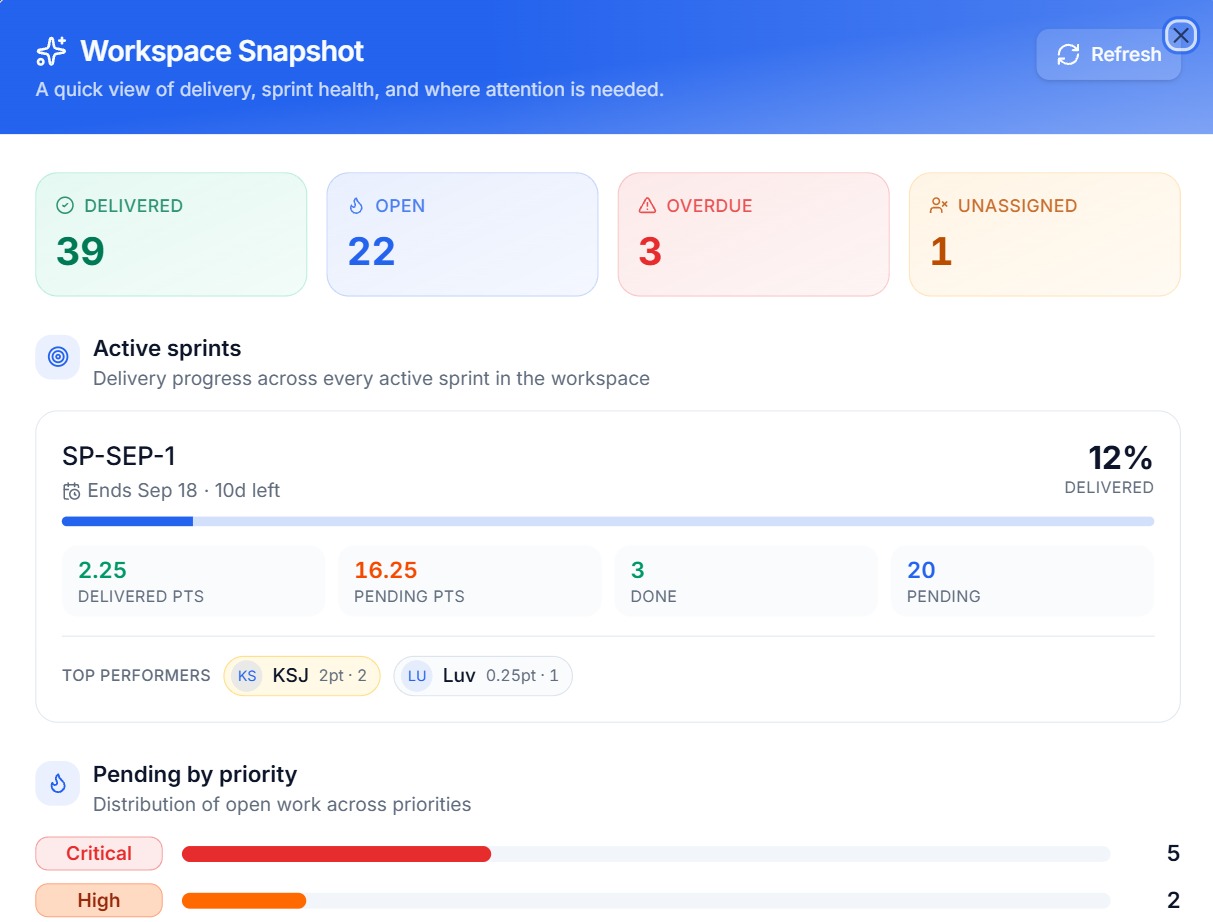
6. Replace status meetings with snapshots
Daily snapshots give team members a clean summary of their sprint — due, overdue, changed — without the PM assembling anything. Managers and owners get the workspace-level view. Automatic notifications for mentions, assignments, and sprint-ending risks mean fewer "quick sync?" messages.
7. Work from Claude, ChatGPT, or Cursor
Doezze connects through MCP with 21 tools, so you can say to Claude: "Create a high-priority bug in the mobile project, assign it to Priya, 2.5 points" — and it is done, with a full audit trail.
What this adds up to
- Planning — blank page to draft plan in minutes
- Status — chasing people to asking the AI
- Risk — end-of-sprint surprises to mid-sprint predictions
- Estimation — inconsistent guesses to validated estimates
- Knowledge — re-solving old problems to semantic recall
- Meetings — status theatre to automatic snapshots
- Execution — form-filling to natural language
Compound those across a week, and a PM gets back the hours coordination used to eat — the hours that should go to unblocking people, managing clients, and making the calls only a human can make.
The teams that win are not the ones with the most process. They are the ones whose tools absorb the process for them.
Read the full breakdown and try Doezze free for a month at doezze.com.
Weiterlesen
HR Reports in Doezze: Performance Reviews Backed by Real Work Data
Doezze HR Reports turn delivery, time-tracking, leave and recognition data into eight ready-to-use reports for review cycles — with time windows and one-click CSV export.
ComparisonBuilt-In Sprint Prediction: Know How Your Sprint Ends Before It Ends
Doezze Sprint Prediction helps teams forecast whether an active sprint is on track, delayed, overlapping, or at risk before the sprint ends. It analyzes burn rate, remaining work, team capacity, workload, leaves, delayed tickets, and overlapping assignments to identify potential risks early. With AI-powered risk scoring and regular prediction updates, teams can make informed decisions, balance workloads, and take corrective action before sprint delays impact deadlines.